Closing the Slack Enterprise Guest Provisioning Gap with SCIM
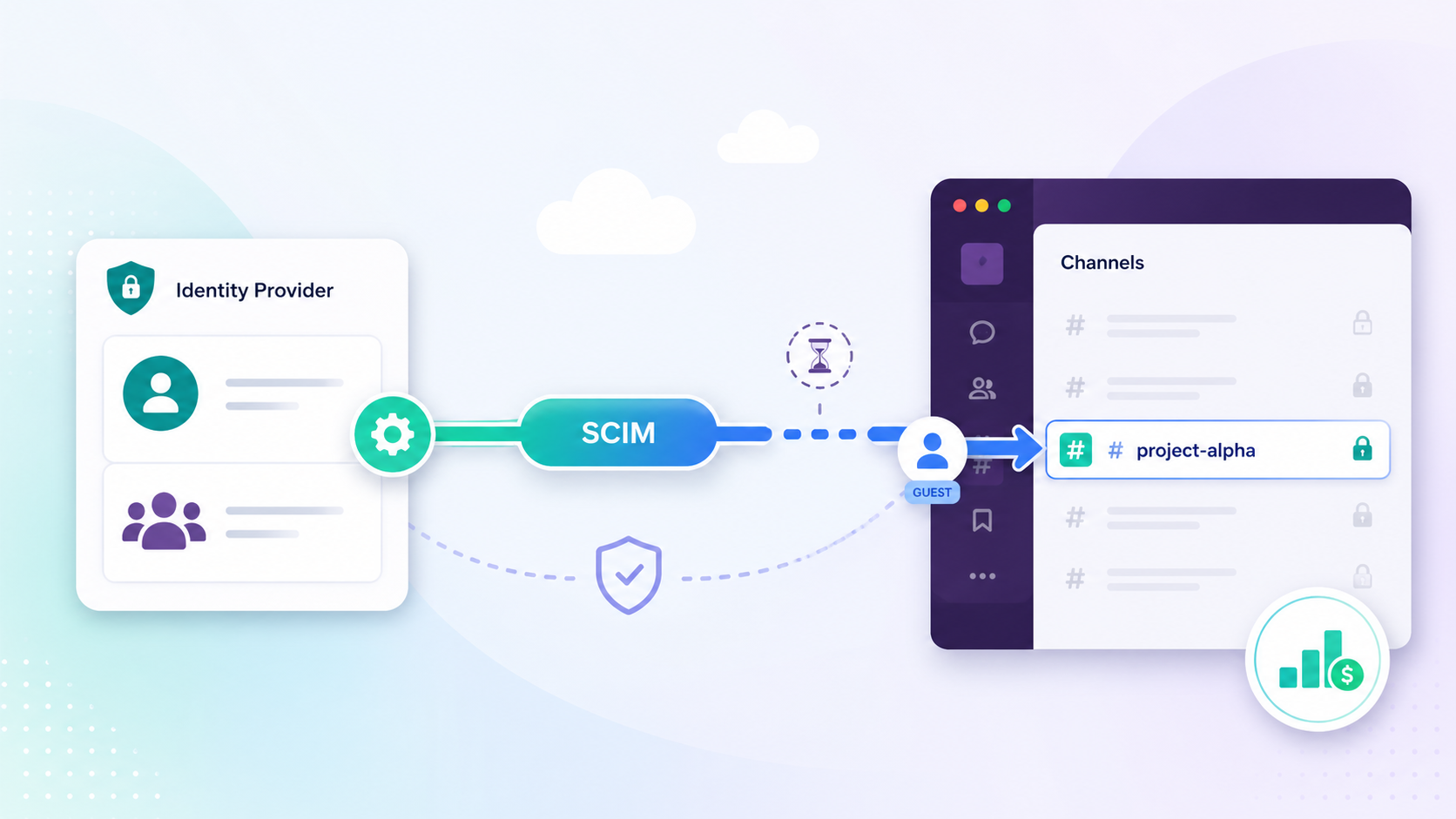
Slack Enterprise Grid is now one of the most expensive collaboration platforms in most IT budgets, and many organizations are actively reducing spend by moving contractor, partner, and limited-access users from full members to guest accounts.
That strategy is smart on paper. In practice, there has been a major identity lifecycle gap: single-channel guests cannot be cleanly provisioned, updated, and deprovisioned from most IdPs using native SCIM.
The result is a lot of manual admin work, inconsistent offboarding, and avoidable licensing waste.
The Problem: Native SCIM Support Is Uneven for Slack Guests
Most teams already use SCIM from their IdP for full Slack members. But when they try to extend the same automated lifecycle to guest users, they run into limits:
- Single-channel guests are not straightforward to automate via native IdP SCIM integrations
- Multi-channel guest support exists in some paths, but is operationally clunky
- Guest channel assignment and type handling often require manual Slack admin workflows
So organizations end up with two systems:
- Automated provisioning for employees
- Manual provisioning for guest users
That split creates friction right where security teams need the most control: external users and temporary access.
The Hidden Cost of Manual Guest Lifecycle Work
When guest lifecycle is manual, the overhead adds up quickly across IT, security, and workspace admins.
1) Provisioning Delays
Admins have to manually invite users, set guest type, and assign channels. This slows down onboarding for contractors and partner teams.
2) Deprovisioning Risk
Without reliable IdP-driven deactivation, offboarding can lag. Delayed removal for external identities is one of the most common enterprise access risks.
3) Ongoing Admin Burden
Profile updates and access changes become ticket-driven tasks. At scale, this creates repetitive operational load and pulls admins away from higher-value security work.
4) Spend Leakage
As Slack prices rise, many orgs are trying to right-size licenses by using guest accounts for narrow use cases. But if guest provisioning is hard, teams default back to full members or leave stale accounts active longer than necessary.
Why This Matters More Now
Slack Enterprise pricing has increased significantly over recent years, and procurement teams are scrutinizing collaboration platform costs more closely than ever.
At the same time, modern companies rely on growing ecosystems of:
- Contractors
- Vendors
- Implementation partners
- Support partners
These users often need access to one project channel or a small set of channels, not the entire workspace.
Guest accounts are the right model for that, but only if lifecycle management is automated and policy-driven.
How Scimify Closes the Gap
Scimify’s Slack Enterprise Guests integration enables SCIM-driven lifecycle management for Slack guest users, including both single-channel and multi-channel guest scenarios.
Scimify receives standard SCIM requests from your IdP and translates them into the Slack Admin API actions needed to:
- Create guest users
- Set guest type (
single-channelormulti-channel) - Apply channel assignments
- Update user profile fields
- Deactivate and reactivate accounts
This gives teams a consistent lifecycle model for guest users that mirrors how they already manage full members.
Security Benefit: Least Privilege with Enforced SSO
Guest accounts are not only a cost control mechanism. They are also a strong security control in Slack Enterprise:
- Restrict visibility to only required channels
- Reduce blast radius for external accounts
- Keep SSO enforcement in place for identity verification and access policy
For contractor and partner access, this combination is powerful: users can collaborate where needed without gaining unnecessary workspace exposure.
Practical Architecture for Enterprise Grid
For many organizations, the cleanest pattern is:
- Primary Slack SCIM app for regular members
- Separate Scimify integration for guest lifecycle
- Dedicated guest SSO assignment path
Separating guest flows helps avoid assignment conflicts and keeps external user governance explicit and auditable.
Bottom Line
Single-channel guest lifecycle has been a stubborn gap in native Slack + IdP SCIM workflows. That gap creates avoidable manual overhead, security inconsistency, and higher effective Slack cost.
Scimify gives enterprises a practical way to automate guest provisioning and deprovisioning while keeping access tightly scoped and SSO-enforced.
If your team is trying to reduce Slack spend without sacrificing control, start by fixing guest identity lifecycle.
See the implementation guide: Slack Enterprise Guests Integration.