Get SCIM on Claude and OpenAI Without the Enterprise Upgrade: How Scimify Compounds Your Savings
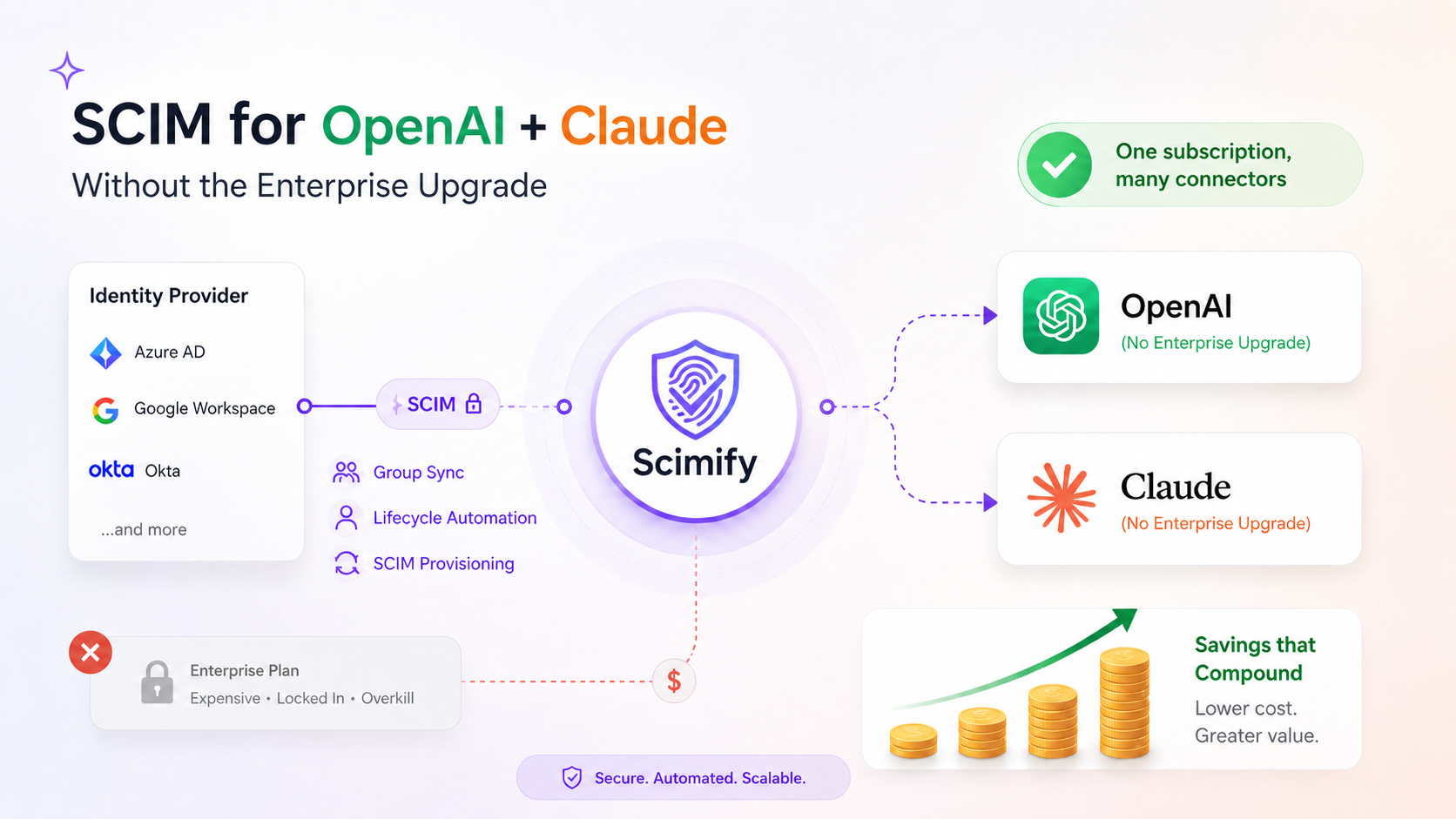
Your security team wants automated joiner/mover/leaver for AI tools. Your finance team wants to stay on Claude Teams or ChatGPT Business—not jump to Enterprise contracts just to unlock SCIM.
That tension shows up everywhere in SaaS: SSO on mid-tier plans, SCIM reserved for Enterprise. The result is manual admin work, delayed offboarding, and procurement conversations that start at “contact sales.”
Scimify closes that gap. New Claude and OpenAI connectors let your IdP drive user lifecycle through standard SCIM—while you keep lower-cost plans that don’t include native directory sync.
The Enterprise SCIM Tax
Both Anthropic and OpenAI follow a familiar SaaS playbook:
| Platform | Lower tier | Native SCIM |
|---|---|---|
| Claude | Teams plan — JIT provisioning and SSO, but SCIM is Enterprise and eligible Console orgs only | Full directory sync, role/seat mapping, group sync |
| OpenAI | Business plan (~$25–30/user/mo) — SAML SSO included, but no SCIM or AD group sync | SCIM, advanced RBAC, custom terms — custom Enterprise pricing |
JIT provisioning helps on first login, but it does not solve the problems IT and security care about most:
- Timely deprovisioning when someone is unassigned in the IdP
- Role changes reflected without manual admin console work
- Group-based access pushed from Okta, Entra ID, or Google Workspace
- Audit evidence that lifecycle events ran automatically
Without SCIM—or an equivalent automation layer—teams fall back to spreadsheets, Slack requests, and quarterly access reviews to catch what should have been removed on day one.
The Math: One Subscription, Many Connectors
Here is where Scimify’s value compounds.
Typical Enterprise upgrade path: You negotiate a Claude Enterprise or ChatGPT Enterprise contract—often a significant per-seat increase over Teams or Business, with annual minimums and sales cycles measured in weeks. And that purchase unlocks SCIM for one application.
Scimify path: Pay per provisioned user on Scimify (from $0.90/user/month on annual plans) with unlimited integrations. The same Scimify users you assign to OpenAI can also provision to Claude, Slack, GitHub, PagerDuty, Looker, and every other connector you enable.
For a 100-person organization, rough order-of-magnitude:
| Approach | Illustrative cost | SCIM coverage |
|---|---|---|
| Upgrade ChatGPT Business → Enterprise | Custom contract; typically well above Business seat pricing | OpenAI only |
| Upgrade Claude Teams → Enterprise | Custom contract; Enterprise seat pricing | Claude only |
| Scimify (100 users, annual) | All enabled connectors |
Scimify’s subscription is often cheaper than upgrading a single SaaS app to Enterprise—and every additional connector you add is effectively free marginal cost on the same user pool.
That is compounding savings:
- First connector — avoid one Enterprise uplift (e.g., OpenAI SCIM)
- Second connector — avoid another (e.g., Claude SCIM) at zero additional Scimify platform cost
- Third, fourth, fifth — Slack guest automation, GitHub teams, Jamf admins… same Scimify users, same subscription
The more of your stack that gates SCIM behind premium tiers, the wider the gap between “upgrade everything to Enterprise” and “one Scimify layer.”
Example: AI Tooling on Business Plans with IdP-Driven Lifecycle
Consider a growing company on ChatGPT Business and a Claude Teams (or Console) organization:
Without Scimify:
- HR offboards an employee in the IdP
- SSO stops working for ChatGPT, but the account may linger until someone remembers to remove it manually
- Claude access requires a separate admin to delete the member or cancel a pending invite
- Group membership in OpenAI is updated by hand in the admin console
- Audit asks for proof of timely removal—you produce ticket screenshots
With Scimify:
- IdP unassigns the user from Claude and OpenAI SCIM apps
- Scimify removes the OpenAI member (or cancels the invite) and drops group memberships
- Scimify removes the Claude organization member (or cancels the invite)
- Audit trail shows SCIM deprovision events with timestamps
You stay on the plans that fit your budget. You get the lifecycle automation your security program expects.
What Scimify Does (and Does Not) Replace
Scimify is built for operational lifecycle management: provision, update roles, sync groups, deprovision. It is the automation layer most teams need to pass access-control audits and stop manual admin toil.
Native Enterprise SCIM may still offer vendor-specific extras—Claude seat-tier mapping via IdP groups, OpenAI EKM, custom data residency, SLAs. If you need those platform features, Enterprise may still be the right choice.
But if your primary gap is “we need SCIM-style provisioning and we are not ready to 10x our AI platform contract,” Scimify is the pragmatic path:
- Keep Claude Teams or Business-tier ChatGPT
- Connect Admin API keys to Scimify
- Assign users and groups from Okta (or any SCIM-capable IdP)
- Extend the same pattern to the rest of your SaaS stack
Getting Started
- Sign up for Scimify — unlimited integrations on per-user pricing
- Follow the Claude integration guide or OpenAI integration guide
- Wire up your IdP with the Okta SCIM configuration docs
- Add your next connector—Slack guests, GitHub, Jamf, PagerDuty—without adding another middleware bill
Enterprise SCIM does not have to mean Enterprise pricing on every app. Pay once for Scimify users, provision everywhere, and let the savings compound as your connector list grows.